

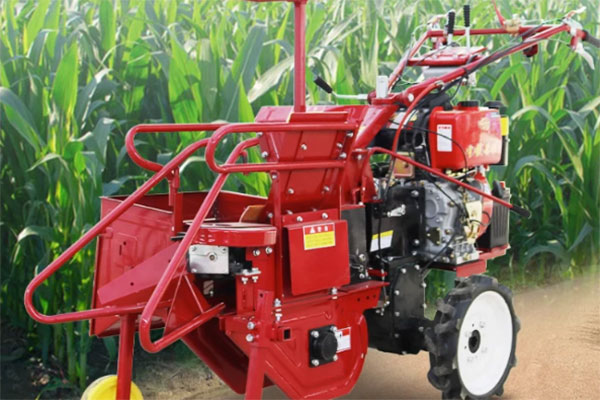

For generations, the image of harvesting corn involved calloused hands, bent backs, and the rhythmic snap of ears being twisted from stalks. While traditional hand-picking is a time-honored method, the agricultural demands of the 21st century require efficiency even on the smallest plots. This leads to a common question among smallholder farmers: How Is Corn Picked By Hand Push Corn Harvester Machine? This article delves into the mechanics, advantages, and practical applications of this transformative piece of equipment, bridging the gap between manual labor and full-scale mechanization.

The Limitations of Traditional Hand Harvesting
To appreciate the innovation of the hand push corn harvester machine, one must first understand the physical toll of manual harvesting. Historically, and still in many parts of the world, picking corn by hand is labor-intensive. Studies from the early 20th century noted that hand husking an acre of corn required an average of 5.23 hours of intense manual labor . This process involves workers walking through the fields, visually identifying ripe ears, reaching up, snapping them off, and throwing them into a wagon or collecting them in sacks.
Beyond the time commitment, the ergonomic strain is significant. Prolonged bending and reaching lead to chronic back pain and fatigue. Furthermore, as global labor forces shift away from agriculture, finding reliable seasonal workers has become a critical bottleneck for small to medium-sized farms. This is where the “hand push corn harvester machine” enters the conversation as a game-changing alternative.
What is a Hand Push Corn Harvester Machine?
Contrary to what the name might suggest, a modern hand push corn harvester machine is rarely “pushed” by human muscle power alone. Instead, it is more accurately described as a walk-behind, self-propelled harvester . It is a compact, single-row machine designed to perform the functions of a large combine but scaled down for small fields, hilly terrain, and greenhouses .
These machines are typically powered by small but robust 5 to 15 HP diesel or gasoline engines . They are not designed for the operator to ride on; rather, the farmer walks behind the unit, guiding it along the rows of corn. The term “hand push” has stuck in the market because it implies simplicity and control, distinguishing it from large, ride-on machinery.
How Is Corn Picked By Hand Push Corn Harvester Machine? The Mechanism Explained
So, how does this machine actually work? When you guide a hand push corn harvester machine down a row, it initiates a three-stage process that is remarkably efficient.
1. Stalk Gathering and Cutting
As the machine moves forward, a guiding mechanism funnels the corn stalks into the cutting area. Unlike a large combine that might rip the entire plant out of the ground, these machines typically use reciprocating blades to cut the stalk near the base, similar to a lawn mower but much more precise . The cutting height can usually be adjusted from 3 to 8 cm to accommodate different field conditions and leave stubble at the desired height .
2. Ears Separation (Picking)
This is the core answer to “how is corn picked”. Once the stalk is fed into the machine, it passes through a set of snapping rollers or a picking mechanism. These rollers are spaced closely together. They grip the stalk and pull it downward with force. The corn ear, being too wide to pass through the rollers, is snapped off cleanly . This mechanical process mimics the human hand twist but does so at a speed and consistency that manual labor cannot match.
3. In-Field Processing: Stripping and Shredding
What happens next is what truly adds value. The harvested ear is conveyed into a threshing drum. Inside, rotating beaters strip the kernels from the cob with an efficiency rate often exceeding 95% . Simultaneously, a built-in fan and sieving system create airflow that blows away husks, silks, and lighter debris, depositing relatively clean kernels into a collection bag or hopper .
Meanwhile, the stripped stalks (which are now lying on the ground or being fed through) are sent through a chipping or shredding unit. The machine’s blades immediately chop the straw into small pieces (typically 10-80mm long) and spread them evenly back onto the field . This process returns organic matter to the soil, acting as a natural fertilizer and reducing the need for burning or manually removing stover.
Hand Push Harvester Key Advantages
Adopting a hand push corn harvester machine offers strategic advantages beyond just speed.
Terrain Adaptability
One of the strongest selling points for these machines is their suitability for mountainous, hilly, and fragmented land . In regions like Southeast Asia, Africa, or the hilly areas of the Americas, large combines simply cannot navigate the terrain or the small field sizes. The lightweight and maneuverable nature of the walk-behind harvester makes it the only viable mechanized option for these farmers .
Cost-Effectiveness for Smallholders
For farmers managing less than 2 to 5 acres, investing in a massive combine is financially impossible. The hand push corn harvester machine presents an affordable entry point into mechanization. With prices varying based on features (basic models can be significantly cheaper than tractor-drawn implements), it lowers the barrier to entry . It allows a farmer to harvest at their own pace, reducing reliance on expensive hired labor.
Soil Health Improvement
Modern versions of these machines solve a major post-harvest problem: what to do with the stalks. By integrating a chipper, the machine facilitates no-till or reduced-till farming by leaving a protective layer of chopped straw (mulch) on the field . This mulch retains soil moisture, suppresses weeds, and prevents erosion.

Choosing the Right Machine for Your Operation
If you are considering a hand push corn harvester machine, you must evaluate your specific conditions. Most machines on the market are single-row pickers, requiring a row spacing of at least 35-40 cm to operate effectively . The ear height is also a factor; most machines require the lowest ear to be at least 60 cm off the ground to be picked efficiently .
Look for models with gear-driven transmissions rather than belt-driven systems, as gears offer more reliable power transfer and durability in dusty, demanding conditions . Also, consider the machine’s weight—typically ranging from 100 kg to 250 kg . Heavier machines offer more stability but may be harder to transport if the fields are waterlogged.
Conclusion
The evolution from hand-snapping corn to guiding a machine represents a significant leap in agricultural efficiency. The question “How is corn picked by hand push corn harvester machine?” is answered by a synergy of simple mechanical principles: cutting, snapping, threshing, and shredding—all in one pass. For the smallholder farmer looking to escape the cycle of labor scarcity and physical strain, investing in a quality hand push corn harvester machine is not just about buying equipment; it is about investing in the sustainability and scalability of their farming future. By adopting this technology, farmers ensure that no ear is left behind, and every stalk serves a purpose in enriching the soil for the next planting season.