

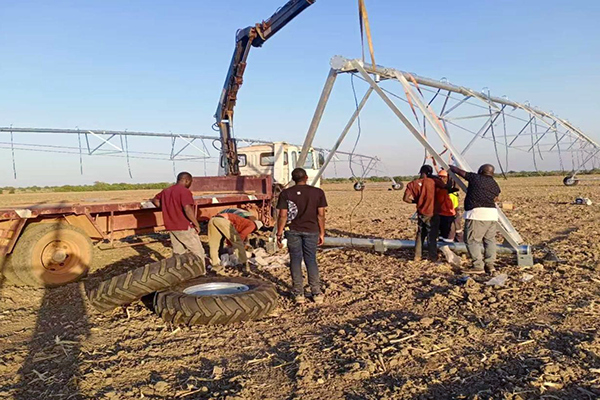

A center pivot irrigation system is an automated sprinkler irrigation system where a long, rotating pipe delivers water to crops in a circular pattern, dramatically improving water efficiency by 30-50% เมื่อเทียบกับวิธีการดั้งเดิม. This method represents a revolutionary shift in agricultural irrigation, transforming how farmers manage water resources and crop production.
How Dose Center Pivot Irrigation System Work?
At its core, อันระบบชลประทานแบบศูนย์กลาง operates on a beautifully simple principle: a long pipeline rotates around a central pivot point, like the hand of a clock. The system is anchored at the center by afixed pivot point, which is typically connected to a water supply such as a well or a pressurized mainline.
The entire structure is composed of multiple segments of galvanized steel or aluminum pipe, supported by a series of wheeled towers. These towers, powered by electric or hydraulic motors, move at a synchronized, slow pace. The outer towers travel the farthest distance along the circumference of the circle and set the master pace for the system’s rotation. Towers closer to the center use sensors to detect alignment and adjust their speed to keep the entire pipeline straight.
One complete rotation can take anywhere from2 ถึง 20 วัน, depending on the crop’s water needs and the system’s speed setting. A typical system with a 400-meter (1/4 mile) radius can efficiently irrigate approximately 50-70 hectares in one circle.
Pointer-Type Irrigation Machine Key Components
Understanding the mechanics requires a look at the essential parts that make this technology function:
- Central Pivot Point: This is the heart of the ระบบชลประทานแบบศูนย์กลาง. It houses the connection to the underground water supply and a rotating mechanism (like a sealed swivel joint) that allows the entire structure to turn without tangling hoses or pipes.
- Sprinkler Pipeline: This is the long “arm” of the system, suspended 2-3 meters above the ground by a truss structure. Along its length, nozzles or sprayers are positioned at regular intervals. Crucially, nozzle sizes are not uniform; they are smallest near the center and increase progressively toward the outer end. This design ensures a uniform application of water because the outer end of the pivot travels a much greater distance than the inner end in the same amount of time.
- Mobile Towers and Wheels: These are the “legs” that support and move the pipeline. Each tower is driven independently, and a sophisticated control system ensures they move in perfect unison to prevent the pipeline from bending or buckling.
- Control Panel: The brain of the operation. Modern panels allow farmers to set the speed and direction of travel, monitor system pressure, and even integrate with GPS and soil moisture sensors for fully automated, precision irrigation.
Center Pivot Irrigation System Advantages & Modern Applications
The widespread adoption of theระบบชลประทานแบบศูนย์กลาง is due to its compelling benefits, which extend beyond simple watering.
Core Advantages:
- Exceptional Water Efficiency and Uniformity: Studies have shown these systems can achieve a Distribution Uniformity (DU) of over 92%. This precise application reduces water waste from runoff and deep percolation, typically saving 30-50% more water compared to traditional flood irrigation.
- Labor and Cost Savings: Once programmed, the system operates automatically for days with minimal supervision, drastically reducing labor costs.
- Terrain Flexibility: Unlike many surface irrigation methods that require perfectly flat land, center pivots can operate efficiently on undulating and uneven terrain, opening up more land for productive use.
- Reduced Soil Compaction and Erosion: By minimizing tractor traffic for irrigation and applying water gently, the system helps maintain soil health and structure.
Innovative Modern Uses:
The versatility of theระบบชลประทานแบบศูนย์กลาง has led to creative applications worldwide:
- Fertigation and Chemigation: The system is a perfect vehicle for applying liquid fertilizers or crop protection products directly to the root zone, improving nutrient uptake efficiency.
- Cooling Livestock: Dairy farmers in New Zealand and Brazil run pivots over pastures to cool dairy cows during heatwaves, mitigating heat stress and maintaining milk production.
- Wastewater Reuse: Some operations pump treated wastewater or lagoon water from dairy farms through pivots, responsibly recycling nutrients and water.
- Soil Preparation: In extreme conditions, pivots are used for pre-plant irrigation to soften hardened soil, making it tillable and ready for seeding.
บทสรุป
ที่ระบบชลประทานแบบศูนย์กลาง is a testament to agricultural innovation, transforming a simple idea—watering in a circle—into a global standard for efficient and sustainable crop production. By delivering water with precision and uniformity, it not only conserves a vital resource but also enhances crop yields, reduces operational costs, and supports the resilience of modern farms. As pressure on water resources increases, the technology and principles behind this system will only grow more critical in feeding the world.