

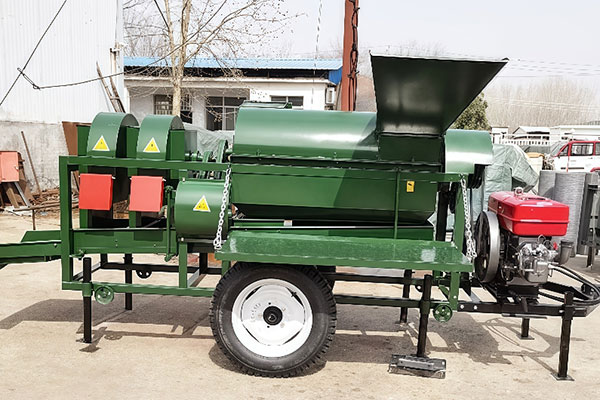

ในการแปรรูปธัญพืชสมัยใหม่, การปรับปรุงประสิทธิภาพหลังการเก็บเกี่ยวเป็นสิ่งสำคัญสำหรับฟาร์มและธุรกิจการเกษตร. อัน นวดข้าวโพด plays a central role in separating maize kernels from cobs quickly while minimizing grain loss. Understanding how a นวดข้าวโพด operates helps buyers, distributors, and farm operators choose the right equipment for different production scales.

Corn Thresher Working Principle
The fundamental function of a นวดข้าวโพด is mechanical kernel separation through impact, friction, and screening. After harvested maize ears are fed into the machine inlet, the internal rotating drum begins the threshing process.
Inside a typical นวดข้าวโพด, a high-speed threshing drum equipped with teeth or rasp bars rotates continuously. As maize enters the chamber, the drum strikes and rubs the ears against a concave screen. This controlled mechanical action allows the นวดข้าวโพด to detach kernels efficiently without excessive breakage.
Once separation occurs, gravity and airflow assist the นวดข้าวโพด in moving kernels downward through the sieve system while larger cob residues are discharged from the outlet. This continuous workflow enables stable operation even under high feeding volumes.
Key Structural Components
A high-performance นวดข้าวโพด normally consists of several coordinated systems:
1. Feeding System
The feeding hopper ensures uniform material entry. Proper feeding design allows the นวดข้าวโพด to avoid blockage and maintain consistent threshing efficiency.
2. Threshing Drum and Concave
This is the core working section of any นวดข้าวโพด. Drum speed and tooth arrangement directly influence separation rate, grain cleanliness, and kernel damage ratio.
3. Cleaning and Screening Unit
หลังจากนวดข้าว, ที่ นวดข้าวโพด uses vibrating screens or airflow fans to remove husk fragments, ฝุ่น, and broken cob particles, ensuring cleaner grain output.
4. Power Transmission System
Whether driven by an electric motor, diesel engine, or tractor PTO, ที่ นวดข้าวโพด converts power into rotational force for stable long-term operation.
Corn Threshers Performance Advantages
Compared with manual shelling, ทันสมัย นวดข้าวโพด significantly increases productivity while reducing labor intensity. Key operational advantages include:
- High threshing efficiency with continuous processing
- Reduced kernel loss and damage rate
- Stable performance under different moisture conditions
A properly configured นวดข้าวโพด can process several tons of maize per hour, making it suitable for cooperatives, grain collection centers, and commercial farms. นอกจากนี้, optimized drum balance allows the นวดข้าวโพด to operate with lower vibration and energy consumption.

Application Scenarios and Equipment Selection
Today, ที่ นวดข้าวโพด is widely applied in smallholder farms, agricultural service providers, and medium-scale maize processing lines. When selecting equipment, users should evaluate capacity demand, power availability, and crop moisture level.
For mobile harvesting regions, a compact นวดข้าวโพด offers easy transportation and flexible field operation. Larger farms often integrate the นวดข้าวโพด into mechanized post-harvest systems to create a continuous maize handling workflow.
บทสรุป
Understanding how a นวดข้าวโพด works reveals why it remains one of the most essential machines in maize post-harvest processing. Through coordinated drum impact, friction separation, and cleaning mechanisms, ที่ นวดข้าวโพด transforms labor-intensive shelling into an efficient mechanical process.
As agricultural mechanization continues to advance, investing in a reliable นวดข้าวโพด ensures higher productivity, improved grain quality, and sustainable farm profitability.